Livestock Vaccination Records: What to Track
On this page
A good vaccination record names the animal or group, the date, the product and its lot number, the dose, the route, the withdrawal end date and who gave it. Buyers, vets and inspectors ask for these details because they are the only proof of what an animal received. This guide covers what to write, why each field matters and how to keep the record without extra paperwork.
Requirements vary by country and species, and your farm's vet decides which vaccines and schedule your animals need. Treat what follows as a record-keeping checklist, not medical advice.
Why the record matters as much as the injection
Withdrawal periods. The FDA defines a withdrawal time as the period after the last treatment during which an animal may not go to slaughter and its milk or eggs may not be sold. The FDA also says improper extra-label use is often the cause of illegal drug residues, usually when a veterinarian is not appropriately involved and the extended withdrawal period is not followed. If you cannot show the treatment date, you cannot show you waited.
Legal duty. Rules differ by country. In the UK, keepers of food-producing animals must record the product name, date, quantity, withdrawal period and animal identity, and keep the records for five years, according to AHDB guidance. In the US, the FDA says adequate records help prevent illegal residues and lists what a treatment record should hold: the drug name, the animal treated, the date of each administration, the total dose, the route, who gave it, and the length and end date of the withdrawal period.
Buyers and programmes. Beef Quality Assurance programmes ask for treatment records. North Dakota State University's BQA certification requirements list treatment record fields such as animal ID, product and lot number, date, dose, route and location, and the earliest date the animal clears withdrawal. Processors and individual buyers may ask for similar proof.
Vets. A vet who can see what was given, when and with what result diagnoses faster and prescribes better.
What every entry should contain
The list follows the BQA record fields, with UK and FDA requirements folded in. "Who gave it" is good practice rather than a BQA field.
| Field | Why it matters |
|---|---|
| Animal or group identity | Shows which animals the entry covers: a tag number, or the group if you treat one |
| Date given | Starts the withdrawal clock and sets the booster date |
| Product name | The brand and formulation, not "the black bottle" |
| Manufacturer's lot number | Lets you trace a faulty batch of product; BQA lists it, and UK rules require the batch number in the record |
| Dose | Underdosing is a common cause of treatment failure |
| Route and location | Injection route and site, so a vet or buyer can see where and how it was given |
| Withdrawal end date | The earliest date the animal can enter the food chain |
| Who administered it | Good practice: accountability, and proof if a vet must sign off |
| Next dose due | Turns the record into an action |
Copy the withdrawal period from the label on the day, not from memory later. Photograph the label if writing out the lot number is impractical. A dated photo beats a blank field.
Where paper records fail
Recording later. Records written from memory at the end of the week contain errors, and errors in withdrawal dates are the dangerous kind. Record at the point of treatment.
Vague group entries. "Vaccinated the young stock" is not a record. If you cannot say which animals in six months, neither can a buyer.
Missing lot numbers. They are the field farms skip most often.
No booster tracking. A record that does not produce the next action is half a record. Boosters get missed on farms that otherwise record well, because nothing surfaced them on the day.
Unrecorded cold-chain failures. Vaccine labels give storage temperatures. If a fridge fails, note it, so you know later why a group had no protection.
Your vet sets the schedule
Disease risk is regional. A vaccine that is essential in one district may be unnecessary a hundred kilometres away, and it differs by species, age and whether the animal is breeding. Ask your vet for a written programme for your region and species, then record every dose against it.
A schedule can be as simple as a table your vet fills in, such as this example to discuss with them.
| Vaccine or treatment | Animals | Due | Booster |
|---|---|---|---|
| Set by your vet | Group or tag numbers | Date | Date |
We do not publish sample vaccine schedules because the right one depends on your location. If you want species context first, see goat farming for beginners, poultry farming for beginners and the cattle breeding calendar, which shows where health work fits in the year.
Record withdrawal as a date
When you treat an animal, write the withdrawal end date, not the duration. "Safe from 13 September" needs no arithmetic under pressure; "21 days" does.
Milk and meat often have different withdrawal times for the same product. Follow the label, and confirm the figure with your vet when you are unsure or using a product off-label. For milk, a single treated cow can contaminate a whole bulk tank, so mark treated animals with a leg band or spray as well as in the record. For meat, the record must survive until sale, which can be months away.
Keeping these records in Livestock Manager
Livestock Manager is built around the habit of recording at the point of treatment. It works on iOS, Android and web, and it needs an internet connection.
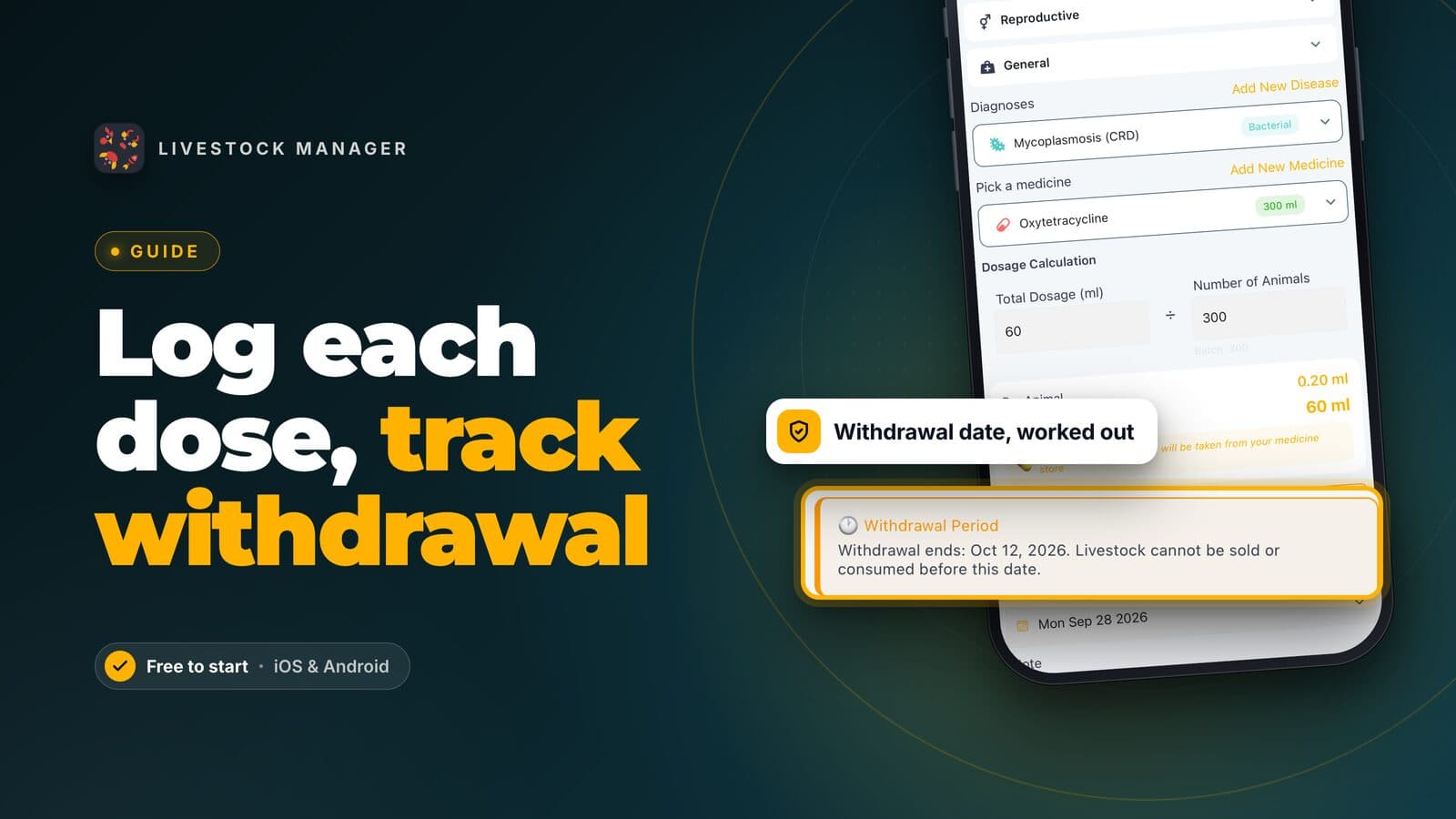
- Health records. Choose Vaccination, Treatment, Medication or Deworming, pick the group, add the medicine and dose, and save. When the medicine has a withdrawal period set, the form shows "Withdrawal ends" with the date.
- Medicine Store. Each medicine holds its type, stock and withdrawal days. Our lesson on health records and medicine stock shows both screens. Recording a dose deducts stock, and the store flags low stock, expired medicine and stock expiring soon.
- Notes and attachments. The health form has a note field and attachments. Use them for the lot number, the route and who gave the dose, and attach a photo of the label. There are no separate fields for these, so write them in the note in the same order every time.
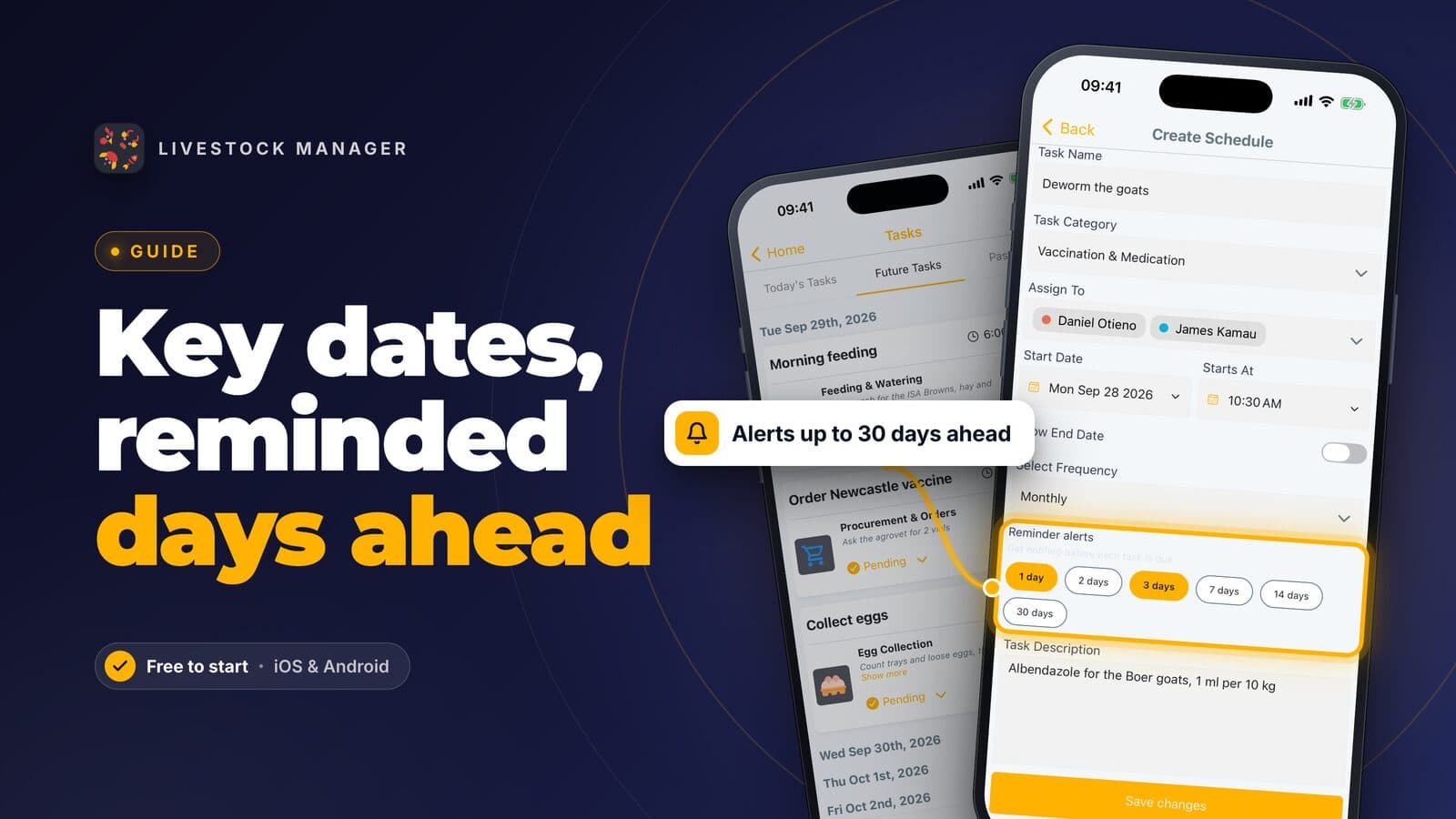
- Tasks and reminders. Create a task in the Vaccination & Medication category with a due date, or a repeating one, so a booster shows up on the day instead of in a notebook. Our lesson on farm tasks and reminders shows how.
- Reports. Health history can be downloaded as a PDF to show a buyer or vet.
Two limits are worth knowing. The withdrawal date comes from the single figure stored for each medicine, so check it against the label for the product and for what you sell (milk, eggs or meat). Health records made through the chat assistant do not deduct stock or get a withdrawal date, so use the health form for treatments.
For the wider system these records belong to, see our farm record keeping guide. For what preventable losses cost, see is livestock farming profitable?.
Start with the next injection
You cannot reconstruct records you never kept. Start with the next animal you treat. Write the nine fields, set the next due date in the same sitting, and keep the record where the treatment happens. Within one season you will have a history worth showing a buyer, and a schedule that tells you what is due before it is late.
FAQ
What should a livestock vaccination record include?
At minimum: the animal or group treated, the date, the product name and manufacturer's lot number, the dose, the route and location of the injection, the withdrawal end date and who gave it. Add the next dose due date so the record becomes an action.
How long should I keep livestock treatment records?
It depends on where you farm. UK rules require records of medicines given to food-producing animals to be kept for five years. Check the rule for your country and species with your vet or agriculture authority, and keep records at least that long.
Why do I need to write down the withdrawal end date?
Selling milk, eggs or meat before the withdrawal period ends can leave illegal drug residues in food. Writing the end date, not just the number of days, means anyone can check it at a glance.
Who decides my vaccination schedule?
Your farm's veterinarian. Disease risk varies by region, species and age, so ask your vet for a written schedule and record every dose against it.
Can Livestock Manager keep vaccination and medicine records?
Yes. Livestock Manager has health records that log the medicine, dose and withdrawal end date, a Medicine Store that tracks stock and expiry, and tasks you can schedule to remind you of boosters. It needs an internet connection to work.